
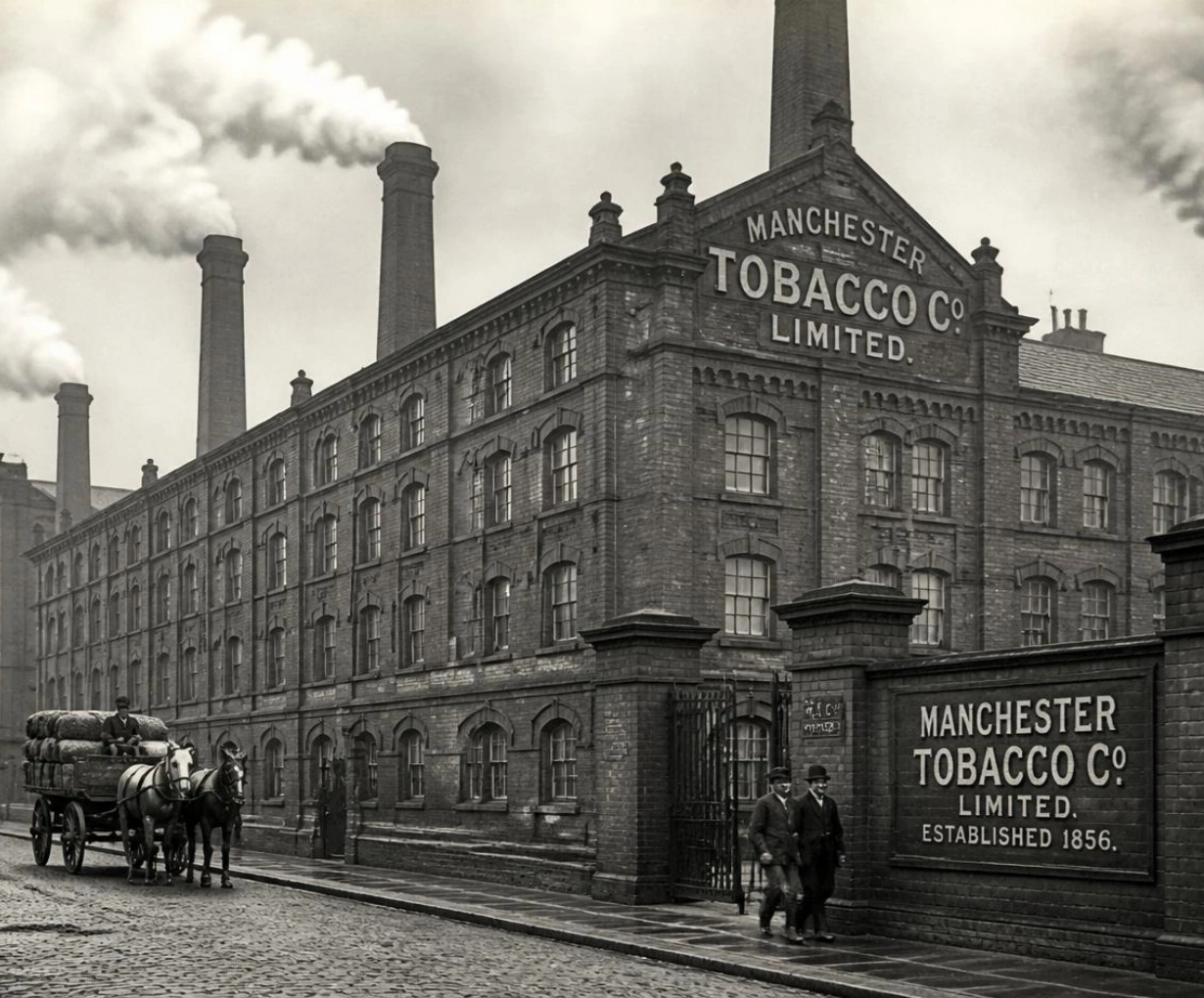

In the heart of England’s industrial revolution, a city built on cotton, steam, and iron quietly forged another legacy. This legacy would span generations and cross oceans. Today, that legacy is remembered as a cornerstone of Manchester tobacco history.
At Smomart, we believe every great product has a story. We invite you to explore the rich heritage behind one of the most iconic names in tobacco history.
The Pipe Makers of Manchester
Edward Pollock arrived in Manchester in 1879. He was a Scottish craftsman. He opened a small clay pipe workshop on Kirk Street, north of the city centre.
Pollock was born in Leith in 1841. He had learned the pipe-making craft at a firm in Scotland. Then he made the journey south to Manchester.
What he started that year became a family business. The business survived for 111 years. It passed from father to son. His grandson, Gordon, finally sold the company in 1990.
The Pollock family business became the last commercial manufacturer of clay tobacco pipes in Britain. Their work was not merely industrial. It was artisanal. Each pipe was crafted with care. Skilled hands shaped each piece. The techniques had been inherited through generations. Academic volumes today preserve the story of Pollocks of Manchester. These books are dedicated entirely to the history and products of this single firm. This dedication proves the enduring significance of their craft.
The Tobacco Manufacturers
Manchester was home to more than just pipe makers. The city housed some of the most significant tobacco manufacturing enterprises of the era.
R. J. Lea & Company
R. J. Lea & Company established their business around 1850. They became famous for creating one of the first well-known tobacco mixtures. They marketed this mixture under the name “Boardman’s”. People said this blend was “still sold wherever English is spoken”.
By 1914, R. J. Lea had expanded into a full-scale manufacturing operation. They produced cigarettes and pipe tobacco at their “Chairman” Factory on Broughton Lane. Their Chairman tobacco came in three strengths: Boardman’s (mild), Chairman (medium), and Recorder (full).
Muratti & Sons
The Muratti family opened a warehouse and factory in 1885. They chose a grand building on Whitworth Street in Manchester. The family business had roots stretching back to 1821 in Constantinople. There, the family cultivated and traded tobacco.
From their Manchester base, Muratti & Sons built an enormous trade network. This network stretched worldwide. They secured contracts to supply Turkish cigarettes to the tobacco monopolies of France and Italy. Their products achieved remarkable quality. People described them as “smoked by Royalty and Nobility”.
The Muratti name gained widespread respect. In 1899, D. B. Muratti presented a cup to the Manchester Wheelers’ Club. The cup was valued at 100 guineas. It was for an annual cycling race. The Muratti Gold Cup is still presented to this day. This century-old connection links a tobacco family to the sporting world.
Across the Ocean — Tobacco in Australia
The story of tobacco in Australia begins long before the first British settlers arrived. In the early 1700s, visiting Indonesian fishermen first introduced tobacco to Indigenous communities in northern Australia.
When the First Fleet arrived in 1788, British patterns of tobacco use arrived too. Soldiers wanted tobacco. Free settlers wanted tobacco. Even convicts wanted tobacco. It was considered essential for keeping order in the colony. Convict ships often picked up tobacco from Brazil on their way to Australia. This ensured a steady supply for the new settlement.
In the decades that followed, tobacco became deeply woven into the fabric of Australian life. It became a cultural thread connecting the old world to the new. This chapter of Manchester tobacco history would eventually link two continents.
A Legacy Continued
Today, the great factories of Manchester’s tobacco era have largely fallen silent. The Pollock pipe works have closed. The R. J. Lea factories have stopped production. The Muratti warehouses now stand empty. These places are now memories preserved in history books and museum collections.
But the legacy of craftsmanship endures. The attention to detail endures. The pride in quality endures.
At Smomart, we draw inspiration from this heritage. We believe that whether it’s the careful crafting of a clay pipe in 1879 Manchester or the thoughtful packaging of an order in 2026 Australia, the principles remain the same. Quality matters. Care matters. Respect for the customer matters.
This is the story behind the name. This is the spirit we carry forward. Understanding Manchester tobacco history means understanding the values that still guide us today.
Smomart — Australian e-commerce, built on a foundation of quality and trust.
Learn more: Discover the story of Manchester cigarettes in Australia →
External resource: Explore tobacco history at the National Library of Australia
[…] From Manchester Mills to Global Shores […]
[…] From Manchester Mills to Global Shores: A Tale of Craftsmanship and Legacy The Name “Manchester” in Australia: A Story of Market, Price, and Phenomenon […]